
Types of Bingham County Deeds
The Bingham County Recorder keeps the county's official books, records, maps, and papers. The office does so under Idaho Code 31-2401. A deed records a conveyance. Other instruments, such as mortgages, deeds of trust, releases, assignments, liens, powers of attorney, plats, and surveys, may sit alongside deeds in the property records. But they answer different questions. Check the document label before treating any instrument as an owner change.
| Deed Type | What It Does | Common Use |
|---|---|---|
| Warranty deed | Conveys the stated estate with deed warranties | An ordinary land transfer |
| Quitclaim deed | Conveys the grantor's interest, if any | Interest transfers and title cleanup |
| Trustee or executor deed | Conveys through a named fiduciary role | Trust, estate, or authorized sale |
| Tax deed | Records the result of the county tax-deed process | Long-delinquent property |
| Plat or survey | Records mapped land divisions or survey work | Legal-description and boundary research |
The Idaho Recorder's Manual offers two Bingham County examples worth studying. One instrument, numbered 748189, carries a warranty-deed label. Another nearby, 748160, indexes a substitution of trustee. That second label concerns a deed-of-trust role and does not automatically convey anything. Sequence in the books can mislead. So document-type analysis always has to come first when you work through deed records.
Bingham County Deed Index Access
Bingham County publishes no official online grantor-grantee index for deeds. No image login, result cap, or coverage year exists to cite. Treat deed records as counter and written-request material. That holds unless the Recorder announces a newer official service. The office sits at 501 North Maple Street in Blackfoot. Its public page lists 208-782-3160.
Ask the clerk to run full grantor and grantee names. Include the approximate recording date, instrument type, legal description, and parcel number if the office accepts it. Ask also which index years or volumes were checked. A negative search means little without that scope stated.
For current access details and fees, use the Recorder's official contact and fee page.
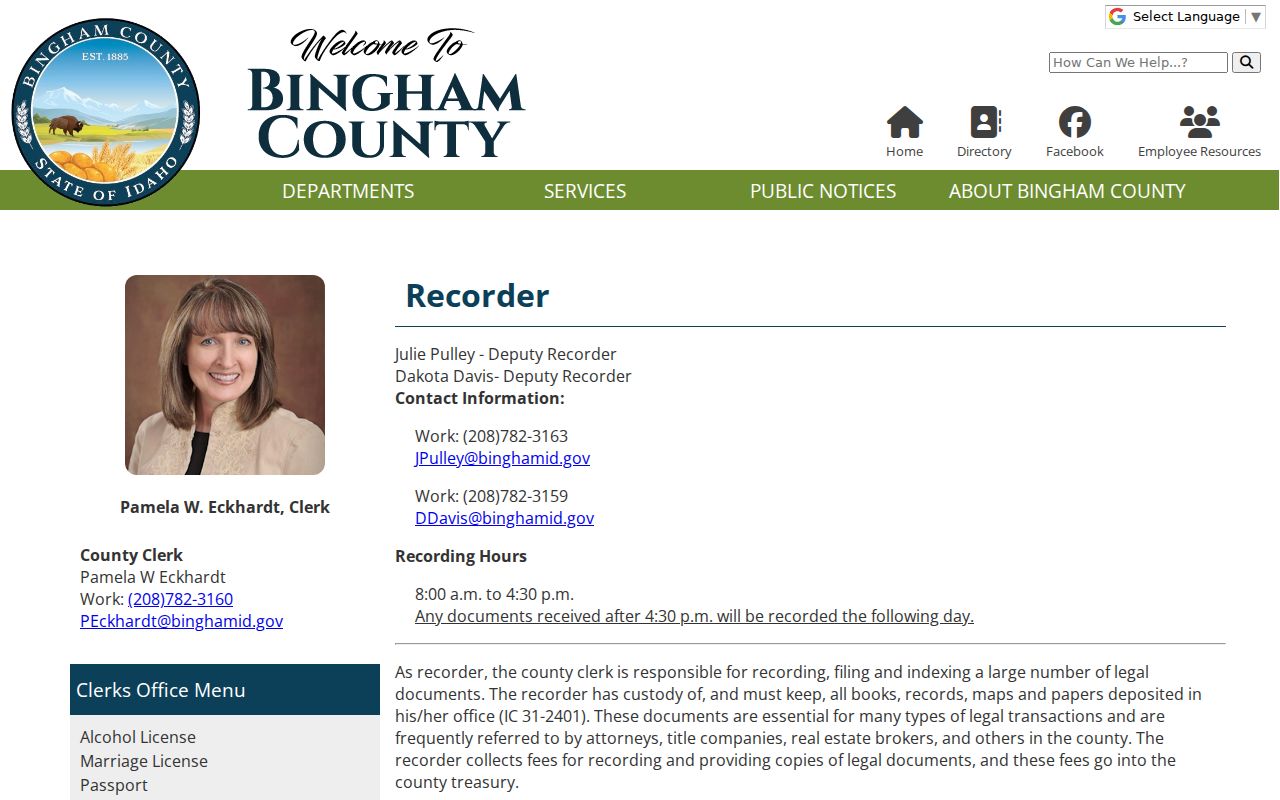
The Recorder's page lays out the counter route and fee categories, and it offers no online deed-result interface.
Bingham County Deed Recording Time
Same-day recording stops at 4:30 p.m. at the Bingham County Recorder. Documents arriving later are recorded the next business day. That cutoff explains why timing can look out of order. A signed deed, its recording timestamp, and the assessor's owner row may not match one another. Keep the date and exact time printed on the recorded instrument.
Bingham County publishes no precise deed-to-assessor update delay. When records conflict after a closing, the newest accepted conveyance is the stronger timing lead. Recheck the assessor row after its next update. Hold both deed records and tax data in view until they agree.
Build a Bingham County Deed Chain
A chain of title is the ordered run of instruments that conveyed the same land. Bingham County deed records lend themselves to tracing that chain by alternating names. Begin with the current grantee. Then take the grantor named in that deed. Hunt for the deed by which that grantor first acquired the parcel. At every step, match the legal description. Parcels, not names, are what actually connect deed records across time.
- Copy the current public owner name, RP number, legal description, and visible instrument reference from the parcel row.
- Ask for the deed that conveyed the described land to that owner as grantee. Record its number, date, type, parties, and legal text.
- Take the grantor from that deed and search for the earlier deed in which the same party was grantee.
- Repeat only while the land description still matches. Note mortgages, releases, court orders, and estate documents without calling each one a transfer.
- Grantor
- The party who conveys the stated interest.
- Grantee
- The party who receives the stated interest.
- Chain of title
- The linked sequence of transfers for the same described land.
- Instrument number
- A unique recorder reference used to retrieve a filed document.
Names change, and one owner can hold many parcels. The legal description is the thread that holds the chain together. A substitution of trustee belongs in your file of Bingham County deed records. So does a release or an assignment. Just keep each out of the ownership chain itself. None of them functions as a warranty deed.
Read Bingham County Deed Details
The Recorder Manual's Bingham sample for instrument 748189 shows a recording timestamp, two pages, a recorded-for name, a warranty-deed label, and a recording-fee category. It reveals no reliable sale price and no complete party or parcel data. Request the actual image and full index entry before leaning on it in land research or in any property search.
| Recording stamp | Date and time the office accepted the instrument |
|---|---|
| Document type | The recorder's index label, checked against the image |
| Parties | Grantor and grantee names as indexed |
| Legal description | The land conveyed, matched across the chain |
| Reference | Instrument number or book and page supplied by the office |
A recording fee is not the price paid for land. Keep the two figures far apart. The fifteen-dollar category in the sample covers recording only, never consideration for the parcel conveyed by the deed.
Older Bingham County Land Records
Nothing verified shows an online cutoff for Bingham County deeds. So no start year for online coverage can be claimed. Older work begins in the Recorder's books and indexes, with historical sources as leads. The digitized FamilySearch collection covers Bingham County records from 1885 through 1948, including assessment and tax material. But digitization is not proof of a complete deed index.
Bingham County itself dates to 1885. Historical taxpayer names can point toward plats, newspapers, and county volumes. Each clue should still be carried back to a deed and its legal description. The Bingham County historical collection may require an account or depend on image-access rights.
Note: Historical tax rolls offer a research lead. They are not a modern RP-number chain or proof of present ownership.
Liens Among Bingham County Deeds
Mortgages and trust deeds secure debt. Releases or reconveyances show a recorded security interest was addressed. Assignments move a creditor's interest to another party. Easements burden or benefit the described land. All of these Bingham County deed records matter to title research. The owner of record never changes in some of them, yet they still count.
Court orders can affect land too, through foreclosure, quiet title, partition, or probate. Open the official Idaho iCourt portal to find case information. Then request the actual filing from the Bingham clerk.
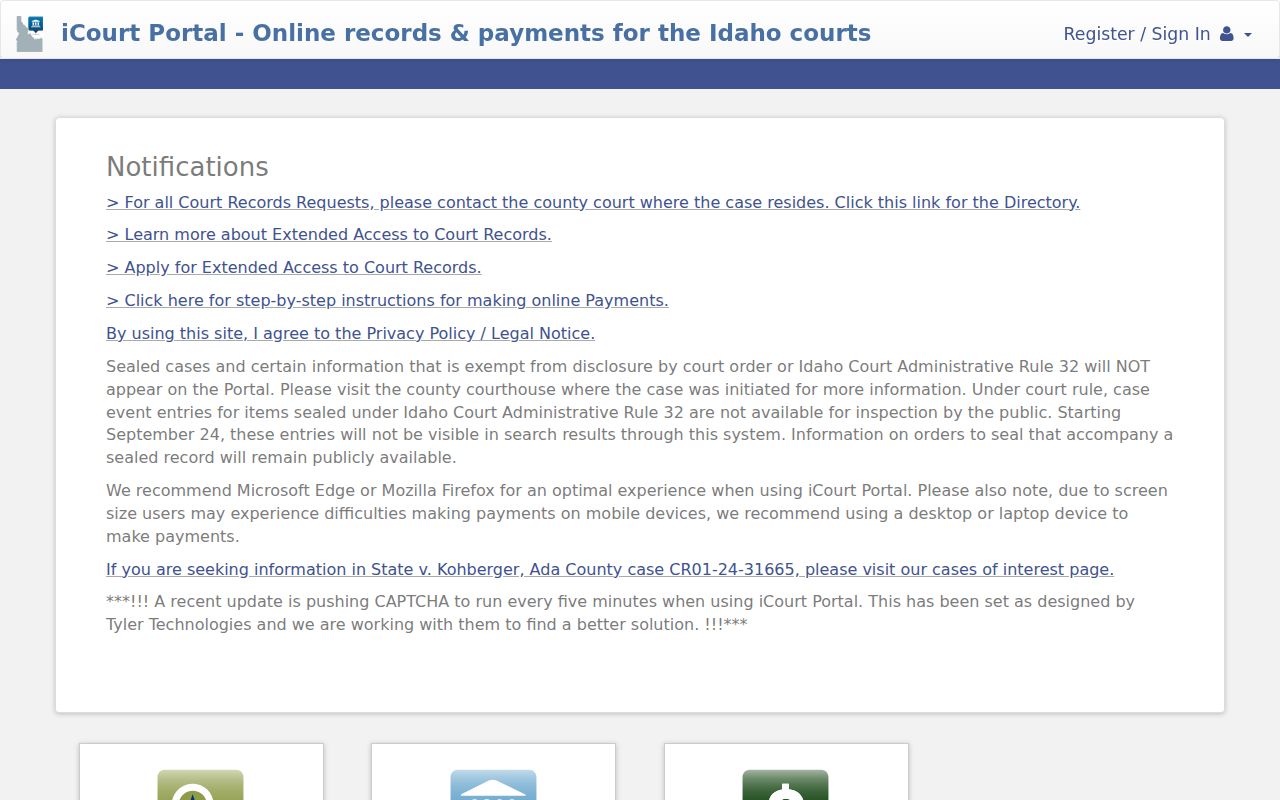
The portal provides the statewide case-search route. Still, the filed order and the matching Recorder instrument remain the evidence to compare against the parcel's legal description.
Order Bingham County Deed Copies
Copies from the Bingham County Recorder run one dollar per page, and certification adds one dollar per document. Survey pages are four dollars each. Recording a deed, grant, or conveyance costs fifteen dollars for up to thirty pages. That figure is a filing fee. It does not buy a copy of a deed already on file. Fees can change, so confirm the current schedule before sending payment.
Any request should include the parties, the document type, the estimated date, the instrument number if known, and the full legal description. Say whether a plain or certified copy is wanted. The office is the only route to the actual deed image in Bingham County property records, since the Recorder is the custodian of those original recorded documents.
Recorded, not guaranteed. A filing proves that an instrument entered the public record. It does not establish clear title or rule out unrecorded interests.
Verify Bingham Payment Requests
The Bingham County Recorder publishes no property-fraud-alert signup. Calling the office directly is the safest way to check. A county planning notice from March 2026 also warns about wire transfers. Legitimate county payments never come by wire transfer. Treat urgent invoices, unfamiliar links, gift-card demands, and cryptocurrency requests with suspicion.
Use contact details from the official county page. Never rely on any number or link inside an unsolicited message. Before sending funds, confirm the instrument number and what the fee covers. Fraud notices can copy real deed filing details from Bingham County property records. The Recorder, as custodian, should always be the final check.